Who decides, and how? Matching decision stakes to decision roles
Decisions stall when people are unclear about the role they’re meant to play. Naming both the type of decision and the role helps everything move faster.

I returned to this draft that I started at the beginning of the year after seeing something that Neil Williams shared in his recent monthnote about 'collaborative stances'.
Last year I shared James Clear's 'hats / haircuts / tattoos' model for thinking about types of decisions.
I had lots of nice feedback that people found the 'hats / haircuts / tattoos' categorisation useful and are using it to help focus conversations about decisions in their organisations.
Of course, a neat categorisation can only take you so far because real day-to-day organisational life is rarely that tidy, and I also know that for some organisations knowing whether or not a decision is a 'hat' or a 'haircut' hasn't stopped them wasting a lot of time on endless discussion.
I think this is because the stakes of a decision are only half the picture, the other half is the role that you are asking (or expecting) people to play in that decision.
Margaret Heffernan made a similar point in an article in which she argued that decisions gain legitimacy when the process is clear enough for people to understand their place within it.
What complicates things in most cultural organisations is not (only) the personalities in the room but the conditions those people are working within.
When expectations about influence and ownership are unclear, even conversations about routine decisions can feel more fraught or more meaningful than they actually are. People try to work out whether they are meant to shape the choice, sense-check it, or simply be kept informed. That uncertainty creates friction, and the emotional reactions that sometimes follow are usually a symptom of that ambiguity.
Being clear about the role people should play in any given decision can help to remove a lot of that uncertainty.
As Dr Carrie Goucher put it when we spoke on the podcast, people don’t expect an equal say in every decision but they do expect honesty about the role they’re being asked to play.
That means being clear when you're asking for input that will actually affect the decision being made, versus situations when you are simply keeping people updated about what's happening.
Without this clarity it's easy to see why every decision, regardless of its stakes, might end up feeling like something that you're asking or expecting people to feed into.
When that clarity isn't present is when you see meetings leading to meetings which lead to more meetings, decisions slow to a halt, people aren't sure how they should be contributing and as a result can get really frustrated and upset when their input isn't received in the way they would like, and trust can take a battering.
This is when you can start to hear things like people don't feel they're being taken seriously, that they feel they're being left out of conversations they should be in, that leaders are being performative, and that's when suspicion about the true motives behind a decision can grow.
Heffernan’s account of Mary Warnock’s IVF committee highlights the same dynamic - unmanaged or unclear expectations about influence are a quick route to mistrust.
Clarity about roles, not just stakes
So I think a more helpful model isn't just "is this a hat, haircut or tattoo" but also whether people are being informed, consulted, or involved (yes I have unimaginatively lifted much of this from RACI/DACI land).
This might feel simple, but I favour simple starting points as this is generally a much quicker and clearer way to work out whether a change will actually work for you.
And coming back to Margaret Heffernan again, she argues that good decisions are ones people can live with because they feel the process was fair. Clear roles in any process are the organisational version of that idea.
So, some definitions:
Inform: The decision is already made, you’re just sharing it for context or alignment. The mistake is pretending to consult when you’re actually only intending to inform (this is a trap I've fallen into in the past). The considerations around sharing information are very different compared to asking for input.
Consult: Input is wanted because it improves the decision, but you (the person asking for input) will still make the final call.
Involve: This is a shared decision and people’s perspectives will directly shape the direction - the group owns the outcome together (linking back to the post that Neil shared - this is closer to, but not always exactly, what they labelled 'co-creating').
It's helpful to separate two quite different questions that often get blurred together.
The hats–haircuts–tattoos model is about the stakes of a decision - it tells you how consequential the choice you're making is and how reversible the outcome will be.
The inform–consult–involve framing is about process, meaning who needs to be part of the decision-making and how.
These two things do not map neatly onto each other. A high-stakes decision does not automatically require high-involvement, and some low-stakes choices still call for genuine consultation because of their knock-on effects. Keeping those questions distinct avoids turning this into a new set of boxes to tick. The point is to diagnose both the nature of the decision and the expectations around influence, then match your approach accordingly.
It is also worth recognising that these dynamics sit within broader structures. Authority, delegation, governance, and resourcing all heavily influence how decisions actually work day to day. Clearer signalling about involvement and roles won't replace the need to engage with those structural questions, although it should make them easier to navigate because when people understand the scope of their influence and how a decision will be made, it becomes simpler to separate what is a process issue from what is a structural constraint, and to address each on its own terms.
The Citizens’ Assembly example in Heffernan’s piece illustrates how explicit framing helps people accept outcomes even when they disagree, and the same applies here.
So if you put these three categories of involvement together with the three types of decision then you start to get something a bit more useful that might guide your approach.
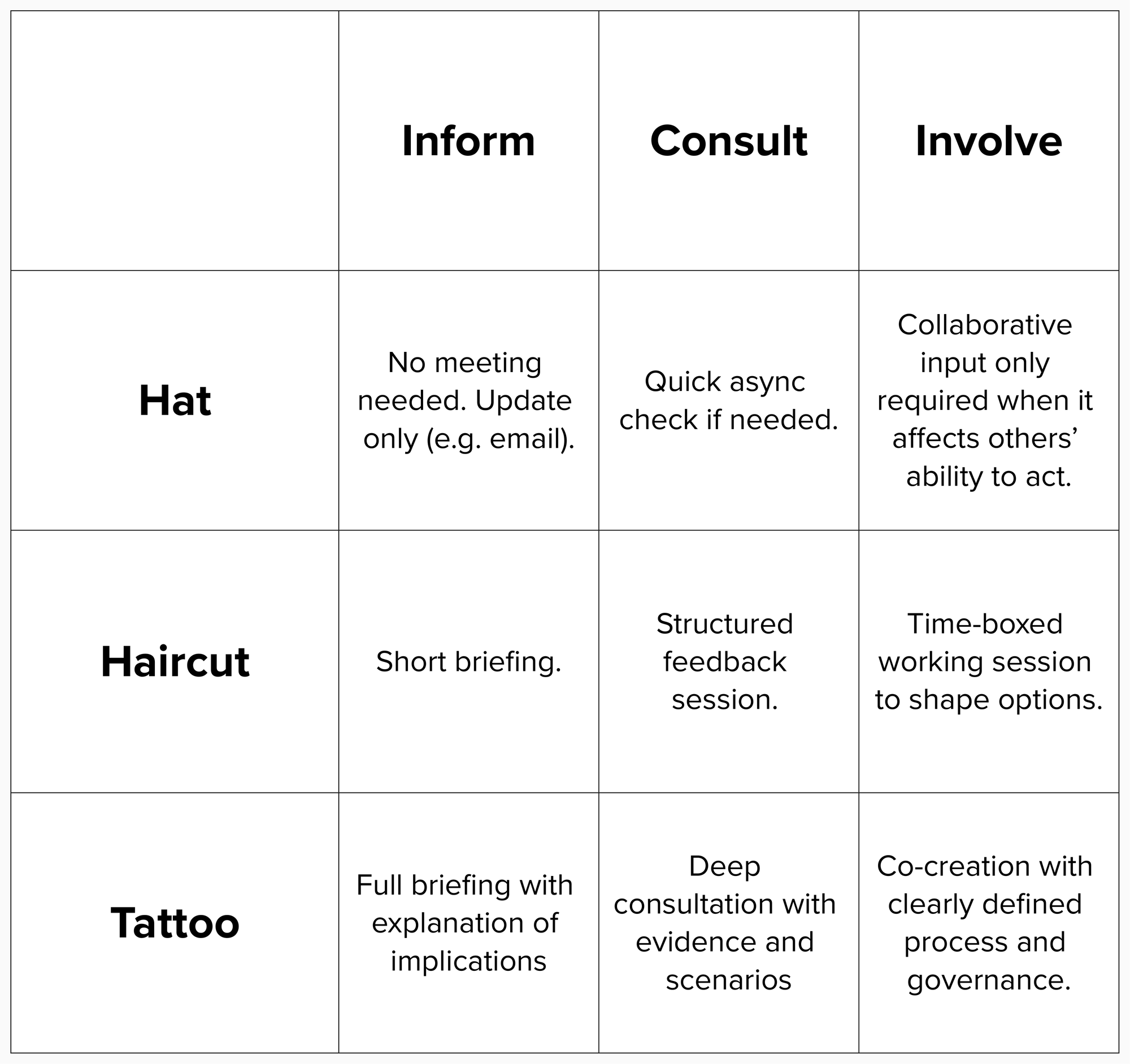
This isn't an exhaustive typology - Consult and Involve can both stretch a bit further than the grid suggests they do. Consult can mean either “react to my draft” or “help me shape a direction” (Julie Penner calls these ‘testing’ and ‘consulting’ in her collaborative stances model) and Involve can mean “choose between these options” or “start from a blank page” - it helps to say which one you mean.
Why this combination should lead to more speed
This will not solve every issue around decision-making, although it can reduce a fair amount of avoidable friction. When you are explicit about both the type of decision and the role people are being asked to play then:
- Meetings get shorter and more focused because people know their job in the room and you don't get bogged down.
- Trust increases because no-one feels misled or invited into a conversation under false pretences.
- You can be selective about who attends meetings (because it's clearer what the meeting is actually for) e.g. if it's a haircut + consult on engaging a freelancer to support some initial planning work, you may not need the whole senior team. If it's a tattoo + involve on redundancies, you can't make the call after a chat with three people in a corridor (this is a flippant example but, you get the idea).
- Decision paralysis reduces because expectations and process are clearer, and the group is not trying to reach a level of input or consensus the decision does not require. People stop second-guessing whether they should contribute, whether they have permission to decide, or whether they're going to be overruled.
- Scrutiny becomes proportionate - haircuts get healthy debate, tattoos get proper structure, and hats stop absorbing time they do not deserve (or need).
A simple meeting habit to adopt
At the start of any decision discussions name the type of decision and the role you want people to play. This works best when used consistently and when the language and specific approach is shaped to fit the culture and norms you already have, rather than shoehorned in.
If people disagree about the type of decision or the role you have communicated, then take time to directly address the disagreement first, don’t just plough on into the decision itself.
It's worth mentioning the importance of psychological safety in all of this. Saying that someone’s input can change the outcome doesn’t mean they’ll then necessarily say what they actually think. In a Consult mode especially, people can drift towards agreeing with the leader and with each other. A few things can help like asking for written input ahead of the discussion, speaking last if you’re the decision-maker, and asking directly what could make this idea fail. If people see their objections being genuinely engaged with and responded to then it's more likely that they will keep offering honest feedback.
Traps to avoid
- Saying involve when you mean consult, this is probably the quickest route to eroding trust. I've watched a director spend 90 minutes in a 'collaborative discussion' about programming choices, only to announce the following week that they'd already committed to the season they were always going to commit to and as a result the team ended up feeling manipulated, not consulted. If you'll genuinely share making the decision, say involve but if you're only seeking input before you will ultimately choose yourself then say consult.
- Treating every tattoo as involve, some big decisions just require someone to make a decision and own it.
- Never using inform, not everything needs input and this can lead to people feeling overwhelmed.
Try it
This is an intentionally simple model.
The aim is to create just enough clarity to reduce avoidable confusion, not to add another thick layer of process.
Simple tools are easier to try, easier to tweak so they fit your culture and context, and easier to stop and drop if they don't actually help.
Let me know how you get on with this, or if you have any thoughts about what I've suggested.
This piece builds on Dr Carrie Goucher's work on effective meetings, James Clear's hat/haircut/tattoo framework, Julie Penner's Collaborative Stances model, and more general work on clarity in roles and responsibilities.